

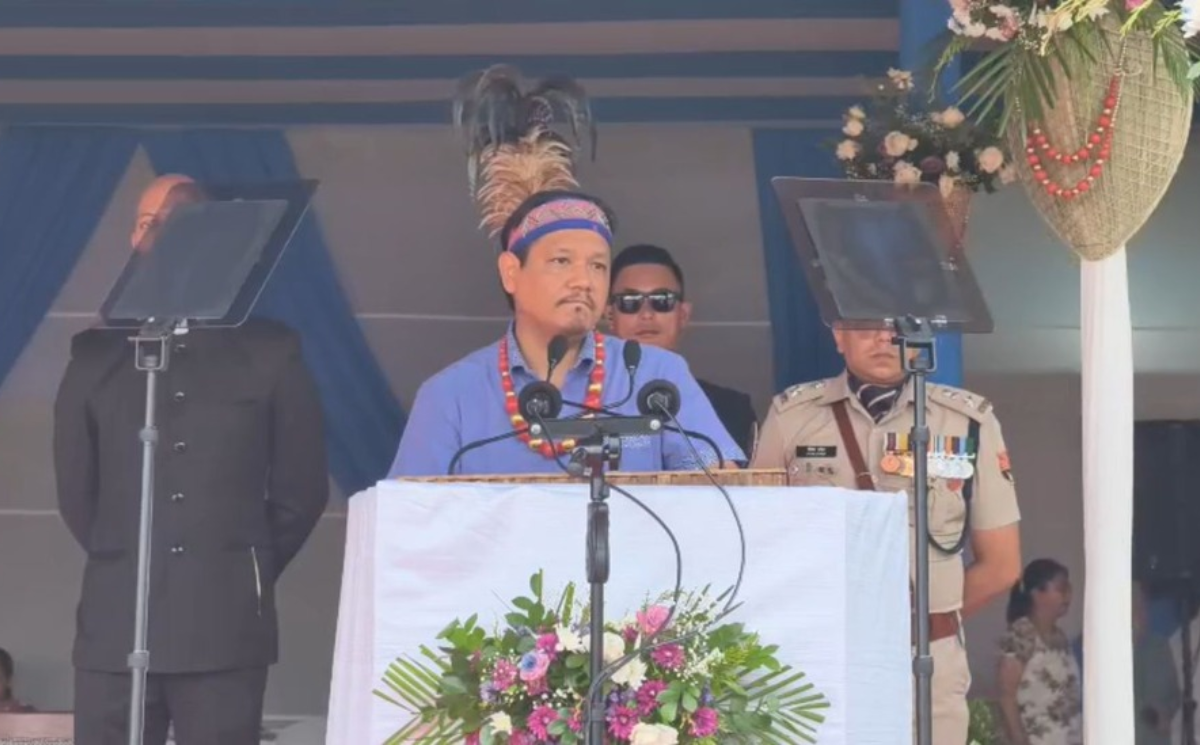
Meghalaya Chief Minister Conrad K Sangma, in his Independence Day address on Saturday, highlighted the state’s economic progress and outlined a development roadmap centred on environmental conservation, employment generation, better public services and preservation of its cultural identity.
Speaking at the Independence Day programme at Polo Grounds in Shillong, Sangma said Meghalaya’s economy had grown substantially since 2018 and claimed that the state had become the third-fastest-growing state in the country over the preceding five years. He credited sustained government efforts and support from the Centre for several of the achievements recorded across the state.
Stay Connected · Headline8
Get breaking news instantly — follow our official channels
Sangma said his administration’s approach was built around three broad priorities: safeguarding Meghalaya’s natural resources, strengthening its people and protecting the state’s distinctive cultural heritage.
The Chief Minister placed considerable emphasis on environmental protection, noting that Meghalaya has around 76 per cent forest cover. Through the GREEN Meghalaya Plus initiative, approximately 63,000 hectares of natural forest have been brought under conservation, with nearly 6,300 farmers receiving annual incentives for protecting forest areas.
He also highlighted efforts to strengthen water security, saying more than 60,000 springs had been mapped and over 500 major water-harvesting structures were being developed.
Agriculture featured prominently in the address. Under CM FARM+, more than 25,000 farmers across Meghalaya’s 12 districts are being encouraged to cultivate high-value crops. The state’s Lakadong, organic, floriculture and ginger initiatives are also aimed at increasing farm incomes and shifting cultivation towards more profitable produce.
To address market-access challenges, Sangma referred to a spice-processing facility at Bhoirymbong in Ri-Bhoi, which has the capacity to process 10,000 metric tonnes of ginger annually. The facility is expected to benefit thousands of farmers across more than 100 villages. The government is also establishing 40 PRIME Hubs to connect producers with markets.
According to Sangma, more than 3,200 km of roads have been constructed over the past eight years. In healthcare, he highlighted a significant reduction in maternal and infant mortality since 2020, while full immunisation coverage has remained around 90 per cent for three consecutive years.
Under the Safe Motherhood Scheme, CM-Safe Motherhood vehicles have transported around one lakh pregnant women to medical facilities, including more than 15,800 women identified as being at high risk.
Education and youth development were also major themes. Sangma said Meghalaya’s score in the national Performance Grading Index had improved considerably, while SSLC pass rates had risen from 57 per cent in 2018 to 97.2 per cent. HSSLC results also improved during the period.
More than 55,000 young people have received training through the CM Skills Mission since 2022. Entrepreneurship programmes such as PRIME and CM-ELEVATE have supported numerous businesses and contributed to thousands of direct and indirect employment opportunities.
Sangma said tourism had become an increasingly important source of income, with annual visitor numbers rising from about 12 lakh in 2018 to nearly 18 lakh. The government is promoting homestays and developing new tourism destinations.
The state’s music industry has also received institutional support. Through the Meghalaya Grassroots Music Programme, more than 8,850 artists have reportedly benefited from over 18,000 performances.
Addressing substance abuse, the Chief Minister said the number of rehabilitation centres had increased from nine in 2018 to 14. He stressed that tackling drug addiction requires more than rehabilitation, arguing that young people also need opportunities in sports, music, education and employment.
On governance and infrastructure, Sangma cited citizen engagement through CM Connect, improvements in power supply and a reduction in transmission losses. He also referred to the 2022 Assam-Meghalaya agreement, which resolved boundary differences in six of the 12 disputed areas.
Looking ahead, he identified New Shillong, the Dhubri-Phulbari bridge and the 39th National Games as important opportunities for Meghalaya’s next phase of development. More than 10,000 athletes are expected to participate in the Games across nearly 39 disciplines.
Despite the progress, Sangma acknowledged that several challenges remain, particularly for villages awaiting improved connectivity, young people seeking employment and families striving for better incomes.
He concluded by drawing an analogy with Meghalaya’s famous living root bridges, which take generations to develop. The example, he said, reflected the importance of patience, collective participation and a long-term commitment to building a stronger future for the state.