
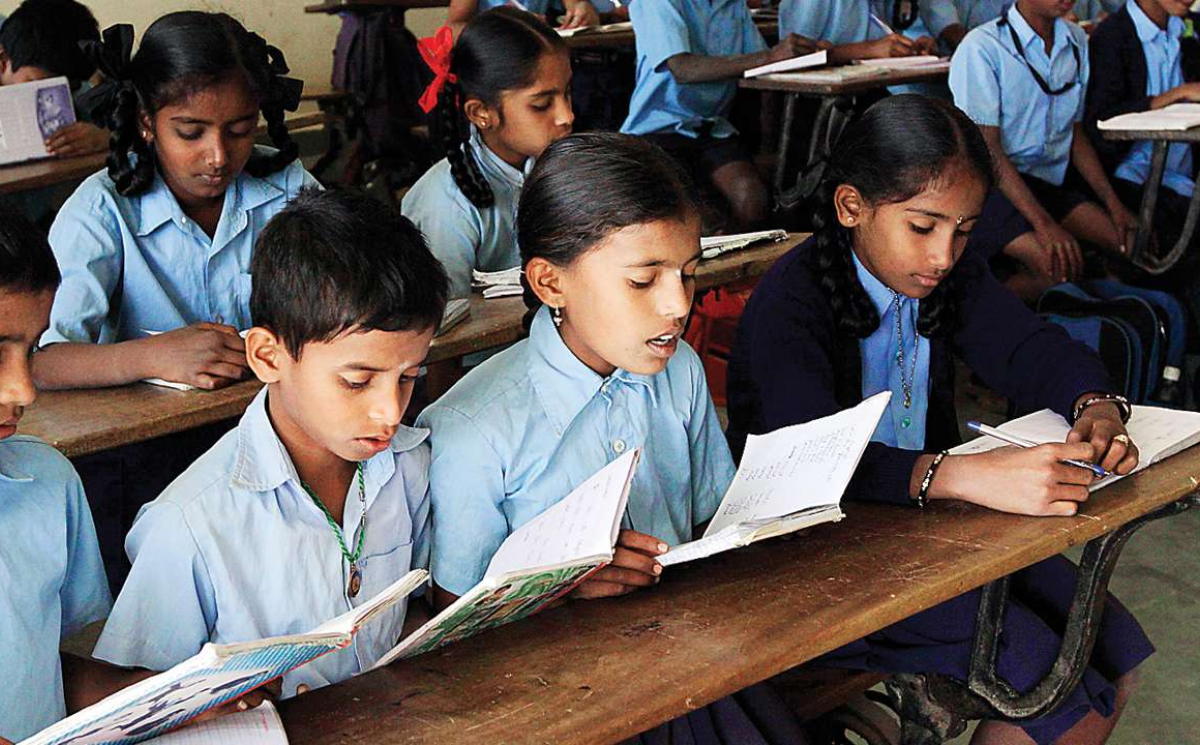
Over the past decade, several sectors of the Indian economy have witnessed increasing privatisation, with a growing share of economic activity being concentrated in private hands. Education, too, has undergone a significant shift, with the rapid expansion of private schools raising concerns over the growing commercialisation of the sector and the gradual erosion of access to publicly funded education.
Recent data published by the NITI Aayog indicates a notable decline in the number of government schools across India, alongside a substantial rise in private institutions. The number of government schools fell from 11.07 lakh in 2014-15 to 10.13 lakh in 2024-25. Government-aided schools also declined from 83,000 to 79,000 during the same period. Taken together, the government and government-aided sectors witnessed a reduction of nearly 98,000 schools.
Stay Connected · Headline8
Get breaking news instantly — follow our official channels
In contrast, the number of private schools increased significantly. From 2.88 lakh institutions in 2014-15, the figure rose to 3.39 lakh by 2024-25—an increase of around 51,000 schools.
The shift is also reflected in student enrolment patterns. In 2014-15, government schools recorded 14.66 crore enrolments, while government-aided schools accounted for 3.05 crore. By 2024-25, enrolment had fallen to 12.15 crore in government schools and 2.47 crore in government-aided institutions.
Private schools, however, recorded the opposite trend. Their enrolment increased from 8.56 crore students in 2014-15 to 9.58 crore in 2024-25.
Assam has witnessed a similar shift. According to recent data presented in the Assam Legislative Assembly, government-school enrolment in the state declined by 7.35 lakh over the past nine years, while private educational institutions recorded an increase of 9.41 lakh students. The figures were disclosed by Education Minister Ranoj Pegu in response to a question raised by Raijor Dal president Akhil Gogoi.
Another set of government data shows that between 2014-15 and 2023-24, the number of government schools across India declined by nearly 8 per cent, whereas private schools grew by 14.9 per cent.
Data from the Unified District Information System for Education Plus (UDISE+) further highlights the changing enrolment landscape. In 2021-22, private schools accounted for 31.1 per cent of student enrolment, compared with 54.9 per cent in government institutions. By 2024-25, the private-school share had risen to 38.8 per cent, while the government-school share had fallen to 49.2 per cent. In 2025-26, private institutions accounted for 40 per cent of enrolment, while government schools accounted for 48.2 per cent.
Thus, compared with 2021-22, the share of students enrolled in government institutions declined by 6.7 percentage points, while the private sector registered an increase of 8.9 percentage points.
The trend has been particularly pronounced in several BJP-ruled states, where government schools have recorded substantial declines. Madhya Pradesh and Uttar Pradesh have witnessed some of the sharpest reductions, with 29,410 and 25,126 government schools respectively disappearing during the period under consideration.
Uttar Pradesh has simultaneously witnessed a significant expansion of private education. The state added 19,305 private schools during the same period. Of the 42,944 private schools added across the country, Uttar Pradesh alone accounted for approximately 44.9 per cent.
Jammu and Kashmir recorded a 21.4 per cent decline in government schools, with the number falling from 23,874 in 2014-15 to 18,758 in 2023-24.
Odisha saw a 17.1 per cent reduction, with government schools declining from 58,697 to 48,671. In Arunachal Pradesh, the number fell by 16.4 per cent, from 3,408 to 2,847.
Jharkhand recorded a 13.4 per cent decline, from 41,322 government schools to 35,795. Nagaland saw a 14.4 per cent reduction, from 2,279 to 1,952. Goa’s government schools declined by 12.9 per cent, from 906 to 789, while Uttarakhand recorded an 8.7 per cent decline, from 17,753 to 16,201.
More recent UDISE+ data indicates that between the 2023-24 and 2025-26 academic years, enrolment in government schools fell by approximately 86 lakh students. During the same period, private schools recorded an increase of more than 88 lakh enrolments.
These figures raise significant questions about the accessibility, quality, equity and long-term sustainability of India’s public education system. Government schools remain a crucial source of education, particularly for economically vulnerable families and those living in rural areas.
The decline in government-school enrolment and the simultaneous rise in private-school participation therefore cannot be viewed merely as a statistical shift. It warrants a deeper examination of India’s education policies, school consolidation practices, infrastructure utilisation and the expanding role of private institutions.
The broader concern is whether the shrinking footprint of government education could further widen existing socio-economic inequalities. As private education becomes increasingly prominent, ensuring affordable, accessible and quality education for all remains a critical challenge for policymakers.