

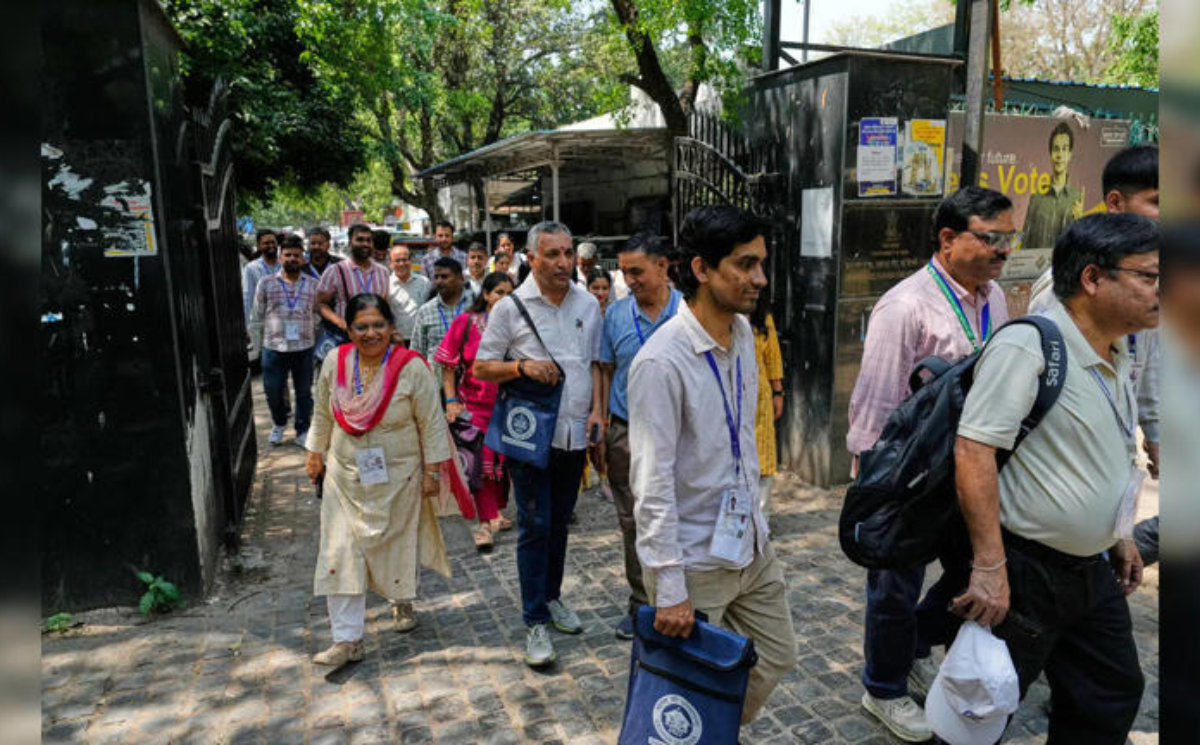
India’s much-awaited Census 2027 population enumeration began on Monday in Ladakh and snow-bound parts of Jammu and Kashmir, Himachal Pradesh and Uttarakhand, marking the start of the country’s first population census in more than a decade. The exercise is being conducted in difficult mountainous and remote regions ahead of the harsh winter months, with residents given the option to submit their details online before officials conduct door-to-door verification.
The self-enumeration window will remain open from August 17 to August 31, 2026. From September 1 to September 30, trained census personnel will visit households to verify and record information using a mobile application. Population enumeration across the rest of India is scheduled for February 2027, with the overall exercise targeted for completion by March 1, 2027.
Stay Connected · Headline8
Get breaking news instantly — follow our official channels
Digital Census With 40 Questions
For the first time, the census is being conducted through a predominantly digital system. Enumerators will use the Census 2027-PE mobile application, which can operate in both online and offline modes, allowing officials to collect information even in areas with poor or no network connectivity.
Residents participating in self-enumeration can submit their household information through the official census portal and will receive a self-enumeration ID. The ID can subsequently be provided to census officials during field verification. Officials have clarified that no OTP will be required for the process.
The Union government has notified 40 questions for the population enumeration phase, 11 more than those included in the 2011 Census. The questions cover several aspects of household and individual information, including caste, parental details, identity documents, mobile numbers, driving licences, permanent residential addresses and Covid-19 vaccination details.
Among the most significant additions is the caste question, being included for the first time in an independent India’s population census. Listed as Question 10, it asks respondents to identify their Scheduled Caste, Scheduled Tribe or caste. The response will be recorded as declared by the individual rather than being matched against a pre-existing list.
Census Begins in Remote Ladakh
In Ladakh, the exercise will cover approximately 274,000 people across seven districts. Jammu and Kashmir will see enumeration involving around 8.81 million residents across 16 districts, including Doda, Poonch and Kupwara.
The region presents considerable logistical challenges, with some settlements located far from motorable roads. Villages in Zanskar, for instance, have limited connectivity, while Yingchen village in Leh has only 11 residents belonging to two families and is several hours away from the nearest habitation.
Hanle village in Changthang, situated at an altitude of nearly 15,000 feet, is another example of the difficult terrain officials must navigate.
Despite these challenges, census authorities have said that even isolated households in remote mountainous locations will be covered. Additional personnel have been deployed in strategically difficult areas, including locations where Army and ITBP personnel are stationed.
Early Enumeration in Himachal Pradesh
Himachal Pradesh is also undertaking an advance population count in areas that become difficult to access during winter. The exercise will cover 6,903 snow-bound villages and areas, particularly in Kinnaur, Lahaul-Spiti and Pangi-Bharmour in Chamba.
One of the notable locations is Komik village in Spiti, located at an elevation of around 15,049 feet and regarded as one of the world’s highest motorable villages. The village, which had a population of 130 in the 2011 Census, is also home to the centuries-old Lundup Tsemo Gompa Buddhist monastery.
The census reference date for these snow-bound areas is October 1, 2026, allowing authorities to complete enumeration before severe winter conditions make access difficult.
Around 20,390 enumerators and supervisors are expected to be deployed across Himachal Pradesh. Officials will use mobile applications along with a dedicated census monitoring system to track field operations in real time.
Uttarakhand to Cover Snow-Bound Villages and Towns
In Uttarakhand, the early enumeration will cover nearly 52,000 people across 131 villages and three towns spread across four districts.
The areas include 69 villages in Uttarkashi, 23 in Chamoli, four in Rudraprayag and 35 in Pithoragarh. The three towns covered are Gangotri, Badrinath and Kedarnath.
Around 162 enumerators and 34 supervisors are expected to participate in the exercise. Military and paramilitary personnel stationed in snow-bound areas will also be enumerated during the same period.
However, due to security considerations, population data relating to military and paramilitary units will be collected in paper form and later entered digitally at the offices of designated special charge officers.
Privacy and Data Collection Concerns
The expanded questionnaire has also raised questions over privacy, particularly because it seeks information relating to identity documents, mobile numbers, permanent addresses and vaccination records.
Officials, however, say that self-enumeration is intended to make the census faster and more efficient by allowing households to enter their information before an enumerator arrives for verification.
The first phase of Census 2027, involving house-listing and housing-related information, had also offered residents a self-enumeration facility.
Census Delayed Since 2021
The Census was originally scheduled for 2021 but was postponed because of the Covid-19 pandemic. The upcoming exercise will be India’s 16th national census and the eighth since Independence.
Once the population count is completed, officials expect the country to receive its first comprehensive population dataset in more than ten years, containing detailed information on caste, education, employment, migration and other socio-economic characteristics.
The compilation and publication of the final results could take another two to three years. The findings are expected to provide crucial demographic data for government policy, welfare programmes, resource allocation and long-term development planning.
(Inputs from Hindustan Times)
Edited by: Moonmoon Borah